News Center

News flash, stay updated on industry trends

Here you can have a deeper and more comprehensive understanding RAYMOND Sincerely invite you to visit and inspect the factory on site

Home / News center

Through-Type Plating Changeovers: Fixtures, Recipes and Trial Approval

2026-11-23

Through-Type Plating Changeovers: Fixtures, Recipes and Trial Approval

A through-type plating line can be mechanically capable of handling more than one workpiece, yet still be difficult to change over safely. The risk is not only moving a fixture. A new product may alter contact points, drainage, line speed, exposed area, recipe identity, rinse carryover and the inspection record. A changeover plan turns those differences into checks that an operator and an engineer can follow.

Routine changeover is different from factory acceptance. It begins with a released product and fixture record, includes the operator’s setup and first-piece decision, and ends with a traceable release or a hold. Keeping that boundary clear helps the buyer request the right evidence from an equipment supplier instead of treating a commissioning demonstration as proof of every future product change.

Start by defining the product families the line is expected to run. List the workpiece or core size, material, surface area, plating metal, coating objective, contact location, support method and downstream inspection. If two channels or several fixtures are involved, show which data belongs to each channel. Do not rely on a product name that hides a change in geometry or chemistry.

Give every fixture a clear identity

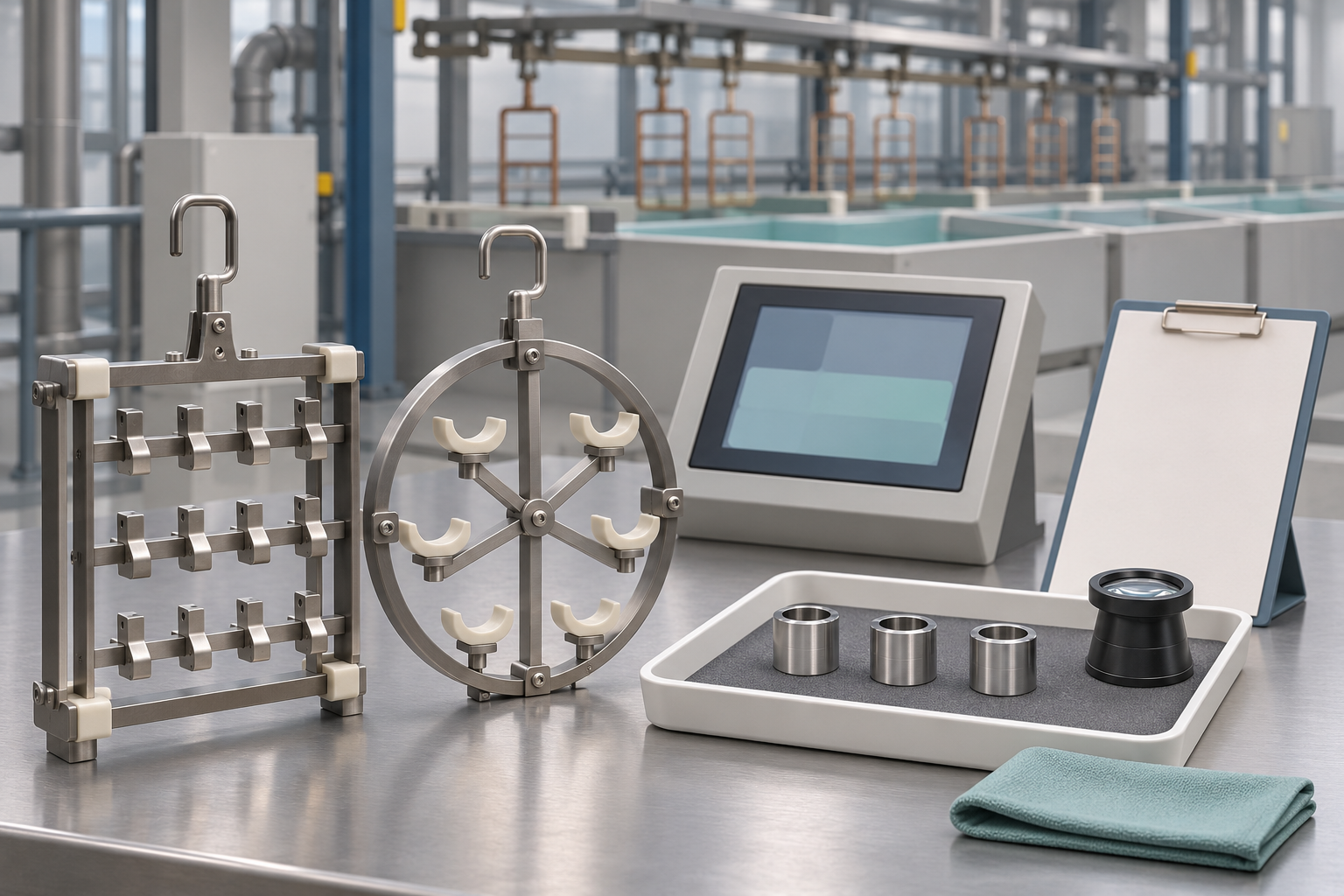
Record the fixture drawing, revision, material, contact points, guide position, wear parts and the workpiece orientation. Mark surfaces that must not be touched and the areas where contact marks are acceptable. A fixture that fits mechanically can still place current in the wrong location or hold a part at an angle that changes drainage.

Before a changeover, inspect the fixture for wear, contamination, loose hardware and contact condition. Define the cleaning method and the release decision. If the line uses a different fixture on the second channel, include the comparison so that one channel is not assumed to match the other.

Link recipe control to the physical setup

A recipe should identify more than a speed or a current value. It should point to the product family, fixture revision, channel, process sequence, chemical route, rinse arrangement, drying condition and inspection plan. If the control system allows an operator to edit a setting, state which changes require a second check and which are locked.

Use a setup sheet that compares the selected recipe with the installed fixture before starting. Confirm the line direction, guide height, contact, sensor state, guard position and alarm response. The purpose is to catch a mismatch while the line is empty, not after a finished batch shows an unexplained change.

Control chemistry and rinse boundaries

When two product families use different plating metals or pre-treatment sequences, identify the stages that are shared and the stages that need segregation or cleaning. A changeover may require a drain, rinse, tank condition check or dedicated route; that decision belongs in the process map. Do not assume that a recipe name alone prevents chemical carryover.

Record the hold point at which the operator confirms the bath, contact and rinse condition. If the line is restarted after a stop, define whether the first pieces are retained for inspection, returned to a previous stage or treated as a separate trial. These rules should be agreed before the equipment is delivered.

Approve the changeover with representative pieces

Trial approval should use a workpiece or substitute that represents the new geometry, contact and surface area. Record loading, line movement, current or process setting, alarm behaviour, drainage, appearance and the inspection result. If a requirement is not yet known, mark it for confirmation rather than filling the gap with a generic acceptance value.

Changeover questionEvidence to retain
Which fixture revision is installed?Drawing, identity, contact condition, wear check and orientation.
Which recipe belongs to it?Product family, channel, sequence, locked settings and approval owner.
What changes in chemistry or rinsing?Shared-stage map, cleaning or drain steps and hold-point confirmation.
What happens after a stop?Restart rule, first-piece disposition, alarm response and operator record.
What proves release?Representative trial, inspection method, open items and sign-off boundary.

Raymond’s official site describes an integrated portfolio of electroplating equipment and automation categories. For a through-type changeover review, send the product matrix, fixture drawings, recipe fields, channel relationship, chemistry map and representative trial plan. A clear changeover record protects the equipment discussion from being reduced to a promise of quick or universal switching.

Related news

23/11/2026
Through-Type Plating Changeovers: Fixtures, Recipes and Trial Approval
23/11/2026
Grinding-Line Integration: Loading, Transfer and Diameter Checks
23/11/2026
Plating Polishing Machines: Pressure, Feed and Dust Control
23/11/2026
Through-Type Electroplating Lines: Compare Dual-Channel Layouts
30/10/2026
Preparing Factory Utilities for a New Electroplating Line
30/10/2026
Plating Tank Materials: Match Chemistry, Temperature and Structural Support
30/10/2026
Plating Line Capacity Planning: From Part Mix to Bottleneck Stations
30/10/2026
Electroplating Bath Filtration: Specifying Particle Control and Service Access
23/09/2026
Transfer System Design for Automatic Plating Lines
23/09/2026
Conductivity Monitoring in Electroplating Rinse Stages
23/09/2026
Heating and Cooling Capacity for Electroplating Tanks
23/09/2026
Rack Contact Design for Stable Current Distribution in Electroplating
31/07/2026
Factory Acceptance Test Checklist for a Custom Automatic Electroplating Line
31/07/2026
Plating Line Ventilation and Fume Extraction for Stable Operation
31/07/2026
Electroplating Rectifier Selection: Current Control, Ripple and Process Stability
31/07/2026
Counterflow Rinsing Design for Lower Water Use and Chemical Drag-Out
26/06/2026
Hard Chrome Plating for Wear Resistance: Extending Service Life in Industrial Equipment
26/06/2026
Nickel-Chrome Plating Systems: Combining Corrosion and Aesthetic Performance
26/06/2026
Copper Plating for Industrial Applications: Conductivity, Adhesion, and Cost Efficiency
26/06/2026
Chrome Plating Technology: A Complete Guide to Bright and Durable Finishes
27/05/2026
Electroplating Wastewater Treatment: Sustainable Solutions for Heavy Metal Recovery
27/05/2026
Zinc Plating Technology: Cost-Effective Corrosion Protection for Steel
27/05/2026
Electroless Nickel Plating: Uniform Coverage for Complex Geometries
27/05/2026
Gold Plating Technology: Precision and Luxury in Surface Finishing
28/04/2026
How to Achieve a Perfect Mirror Finish with Chrome Plating
28/04/2026
Why Choose Raymond as Your Global Plating Automation Partner?
28/04/2026
The Role of Anodizing in Modern Electronics and Architecture
28/04/2026
A Troubleshooting Guide for Your Continuous Plating Line
28/03/2026
The Role of Anodizing in Modern Electronics and Architecture
28/03/2026
Why Choose Raymond as Your Global Plating Automation Partner?
28/03/2026
How to Achieve a Perfect Mirror Finish with Chrome Plating
28/03/2026
The Rise of Plastic Plating: From Automotive to Electronics
06/02/2026
Understanding Electrophoresis (E-coating) Production Lines
06/02/2026
Nickel Plating for the Hydrogen Energy Industry: A Critical Application
06/02/2026
The Importance of a Pickling and Phosphating Line Before Painting
06/02/2026
Solving Common Defects in the Zinc Plating Process
27/01/2026
Hanging Plating vs. Barrel Plating: Which Is Right for Your Parts?
27/12/2025
Blackening Process for Metal Parts: Improving Aesthetics and Corrosion Resistance
27/12/2025
Aluminum Anodizing Process: Enhancing Durability and Corrosion Resistance
27/12/2025
The Critical Role of Tin Plating in PCB Manufacturing and Electronics Assembly
27/12/2025
Silver Plating Technology: Applications and Advantages in Modern Electronics
19/08/2025
Additives in Electroplating Solutions: Functions, Classifications, and Applications—Raymond Helps You Optimize Electroplating Processes
19/08/2025
What is Electroplating? How Does It Work? Raymond Unveils the Secrets
19/08/2025
6 Key Steps to a Successful Nickel Plating Process: Raymond Helps You Achieve Excellence
19/08/2025
Is Chrome Plating Equipment Still Indispensable in Modern Manufacturing? Raymond Provides In-Depth Analysis
28/03/2025
Automated plating equipment to improve efficiency and cost control
28/03/2025
Semiconductor plating process precision needs and technology upgrades
28/03/2025
Technical breakthroughs in chrome plating process and equipment selection guide
28/03/2025
Hot dip galvanising equipment technology full explanation: from principle to selection guide
28/03/2025
The key technology and development trend of industrial plating equipment
01/03/2025
Core Technologies of Copper Plating Lines: Achieving Uniform Coatings & High Efficiency
01/03/2025
Copper plating lines for automotive parts: solutions for corrosion resistance and electrical conductivity
01/03/2025
The efficiency revolution: how automated logistics can reduce labour costs
01/03/2025
Eco-Friendly Copper Plating: Zero Heavy Metal Discharge & Water Recycling
01/03/2025
Copper Plating Quality Control: From Thickness Testing to Adhesion Checks
10/02/2025
Reasons for choosing fully automatic roll plating equipment
09/07/2024
Maintenance of electroplating production line
31/01/2021
Function of Acid Cleaning in Technological Process of Electroplating Equipment

Messsage

If you are interested in our products, you can leave a message below and we will reply to you promptly.
Click to change the verification code
Get quote
Get quote