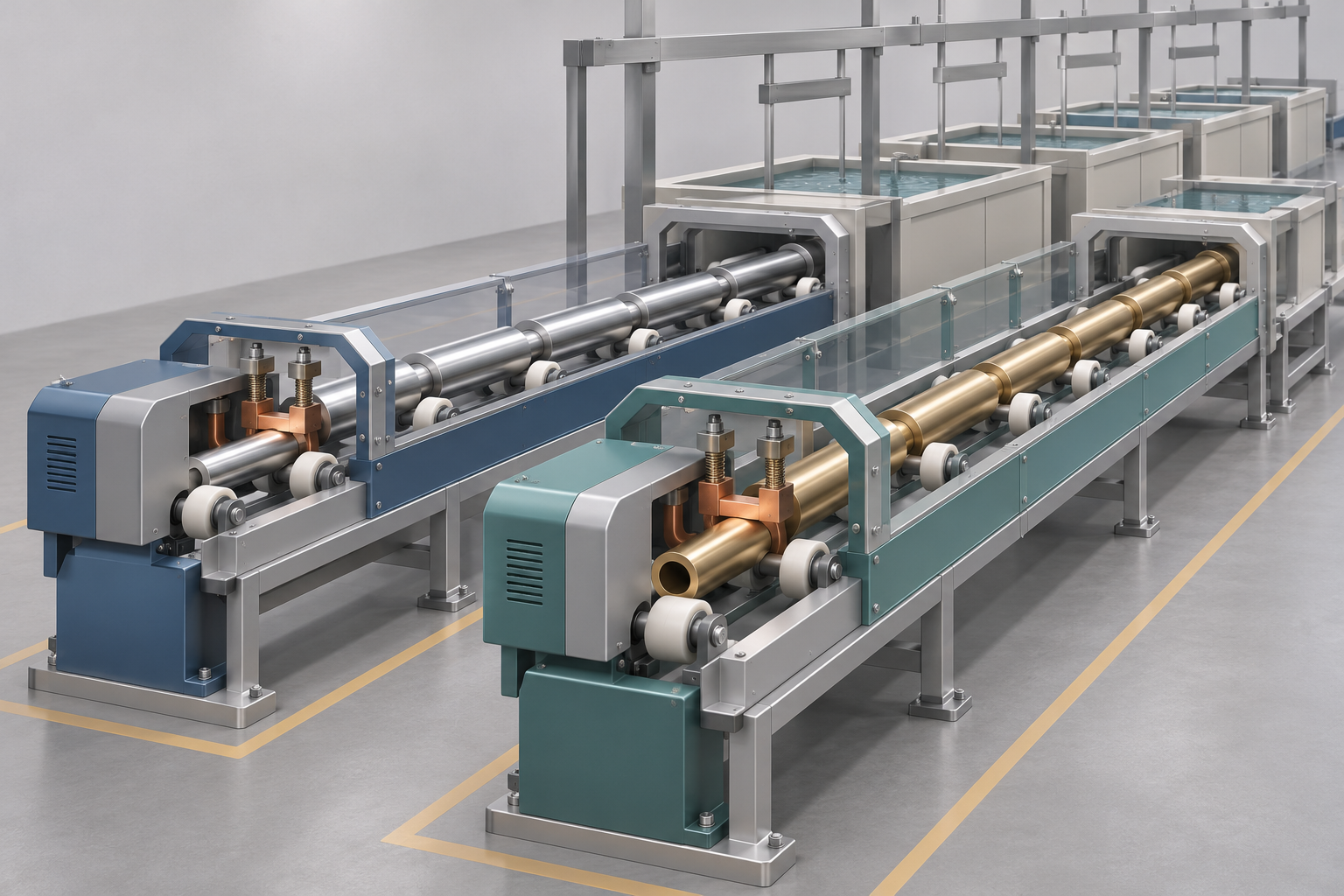
A through-type electroplating line should be quoted from the workpiece route, not from the word dual-channel alone. When two workpiece families or core sizes may run in parallel, the important questions are whether each channel has the required drive and electrical contact, which process stages can be shared, and how the operator will prevent one channel’s settings from affecting the other. A short label can hide a large difference in layout and control responsibility.
The first step is to give the equipment team a product matrix. List the workpiece or mandrel range, length, diameter, material, surface area, plating metal, target coating, line direction, loading method and expected production mix. If two sizes must run together, state whether they require different speeds, current conditions, contact arrangements or process times. Without this information, a channel count is only a drawing assumption.
Define what independent means
Independent drive does not automatically mean independent process control. Ask which motors, rollers, guides, rectifiers, contacts, pumps, dosing points, sensors and operator settings belong to each channel. A shared tank or shared chemical loop may be practical, while a shared contact or speed setting may create a product constraint. Put every shared and separate item into the preliminary layout.
Electrical conduction needs the same clarity. Identify where the workpiece receives current, how the contact is protected from solution or wear, and how the design handles different cross-sections. The contact arrangement should be reviewed with the actual product drawing, not only with an empty line. Record the inspection point for contact condition and the action when a channel loses continuity.
Also define what happens when one channel is empty, stopped or under inspection. Can the other channel continue without changing its electrical or chemical conditions? Which guards, interlocks and alarms are shared? A written answer prevents an apparently independent channel from becoming a hidden single point of interruption during production.
Separate process overlap from process conflict
Two channels may share pre-treatment, rinsing or post-treatment only if the chemistry, carryover risk, drainage and timing are compatible. Ask whether the products need the same cleaning sequence, activation, plating metal, rinse quality, drying route and inspection. If a stage cannot be shared, show the segregation, bypass or sequencing method on the flow diagram.
Pay attention to transfer and drainage. A long workpiece, a smaller core or a different surface area can change how solution is retained and how the product enters the next stage. Note drip time, orientation, guard clearance, access for cleaning and the route for collecting liquid. These are design inputs for the line, not operating promises that can be fixed after installation.
Write the acceptance test around both channels
Before fabrication, agree how each channel will be demonstrated. Use representative workpieces or approved substitutes, record the loading arrangement, run the defined recipe and inspect the contact, coating appearance, line movement, alarms and operator actions. If only one channel is tested, the second channel remains an assumption. If two products are meant to run at once, test the combination that creates the highest interaction risk.
| Quotation question | Evidence to request |
|---|---|
| Which products must run in parallel? | Dimensions, material, surface area, plating route and production mix for each family. |
| Which functions are independent? | Drive, speed, current, contact, sensors, alarms and operator settings per channel. |
| Which stages are shared? | Flow diagram showing chemistry, rinsing, drainage, drying and segregation assumptions. |
| How are changes controlled? | Recipe identity, access levels, changeover steps and confirmation before running. |
| What proves both channels work? | Representative trial records, inspection points, alarms and open-item list. |
Raymond’s official site presents an integrated electroplating automation portfolio covering hanging, roll, chemical, water and continuous plating categories. For a through-type discussion, send the product matrix, channel relationship, electrical-contact sketch, shared-stage assumptions and trial acceptance plan. The final line architecture should be confirmed against the actual parts and chemistry rather than inferred from the channel count.
- Raymond official electroplating automation portfolio
- Raymond official plating equipment production-line overview
- Raymond official contact page
Before comparing prices, ask for a utilities and maintenance map. Identify power, compressed air, water, drainage, ventilation, chemical replenishment, access aisles and lifting points for each channel. Confirm which instruments are calibrated by the buyer, which are included in the line, and where samples are taken. A dual-channel layout can look efficient while creating a maintenance conflict if both channels share a narrow service side. Request a plan view with door swings, contact replacement access, spill containment and isolation points. These checks turn a parallel-running concept into a buildable quotation and give the factory a concrete basis for site review.